Putting new meaning to the phrase ‘2-in-1’

Oak and Iron, Buffalo’s first combination salon and tattoo shop, offers ‘safe space’ downtown

Samantha Vargas | UBSpectrum

sam
SAMANTHA VARGAS | The Spectrum Owners Jessica and Ashley Fox pride themselves on creating a safe-space for patrons and employees by prioritizing the hiring of minorities.

Oak and Iron is breaking boundaries in Buffalo’s tattoo community as the first tattoo shop with a full-service salon, priding itself on being one of the most inclusive studios in the area. 

The shop’s slogan is “keep Buffalo beautiful,” and the owners do just that. Married owners Ashley and Jessica Fox created the shop in response to the “male-dominated” tattoo community, hoping to create a safe space for patrons and employees. They prioritize hiring artists and estheticians from marginalized communities and support the community through charity efforts.

The shop is split in half, offering tattoo services in the front and salon services in the back. Staff specialize in multiple tattoo styles, haircuts and color, nail care, waxing, eyelash extensions and makeup. The location encourages patrons to book appointments in multiple areas to get the most out of the “one-stop shop.” 

Patrons are welcomed in the shop by a sign stating, “We welcome all religions, all races, all countries of origin, all sexual orientations, all genders. We stand with you. You are safe here!” 

The Foxes hope this highlights their passion for uplifting Buffalo’s women and the LGBTQ+ community. They teamed up with Period the Menstrual Movement’s Buffalo chapter to provide Aunt Flow menstrual products in Oak and Iron.

“Although [Buffalo] is kind of behind nearby cities like Toronto or New York City, I think we have the potential to grow and educate the community,” Jessica Fox, also Oak and Iron’s head tattoo artist, said. “The tattoo community is tough. It’s always been male-dominated. We wanted to create a space that was non-intimidating and comfortable.” 
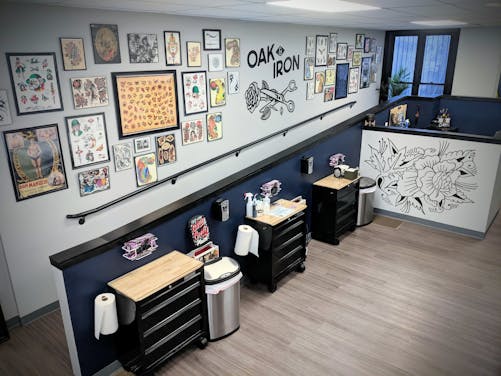
Courtesy of Jessica FoxThe salon offers lunch break and happy hour specials for patrons on-the-go.

The owners are “hyper-aware” when choosing their staff to stay true to their inclusive goals. They even hired employees who are “less experienced” but share the shop’s values.

“When we were searching for staff, we looked for people that were skilled but also had a social awareness,” Jessica Fox said. “People should know that they aren’t going to have an average experience at [our shop]. I want to see more women, more queer and unorthodox artists in Buffalo.”

Brianna Nickerson, a Buffalo resident, has been a client of the Foxes for years. She’s gotten 17 tattoos from them and regularly goes for salon treatments from the owners. 

“For any service, they make sure I’m as comfortable as possible and happy,” said Nickerson. “The knowledge both Jessica and Ashley have for their trades is what keeps me coming back.”

Oak and Iron’s hairdressers are also trained to perform “non-gendered” haircuts and don’t use “gender-based” styling products.

Tattoo artists specialize in traditional Americana, neo-traditional, geometric, dotwork and realistic portraits. The shop also invites guest artists throughout the year to offer something new. The shop minimum is $80, but it also offers a $60 “get-what-you-get” vending machine filled with small flash designs that can’t be customized. 

Located at 176 Franklin St., the shop has cornered the market as the only tattoo studio in downtown Buffalo. It is surrounded by the city courts and convention center, adding a new flair to the downtown area. 

And the owners have big goals for the shop’s future.

“We want to always stay fresh and bring education and youth services to the community,” Jessica Fox said. “But I’m still learning, too. I’ve been told I’m ‘too young’ and ‘haven’t done it long enough’ to get as far as I wanted. But here we are, doing it.”

‘A light at the end of the tunnel’

Anthony Vargas’ journey to student advocacy

Samantha Vargas | UBSpectrum

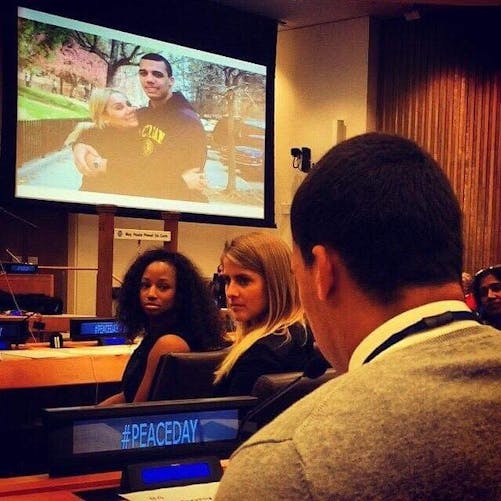
At just 17 years old, Anthony Vargas didn’t know who was watching when he spoke in front of the United Nations on the International Day of Peace in 2014.

 His speech was internationally televised. He may have even been in the same room as President Barack Obama. He wasn’t sure.

What he did know was he shared the stage with renowned scientist Jane Goodall, along with 11 other students, as he spoke about his passion: an anti-bullying program that –– four years later –– is now in the process of being implemented into New York State law.

 It was a lot of pressure for a 17 year old.

But Vargas, a senior sociology and criminology major at UB, has never seen age as a barrier, after taking his bullying experiences at age 11 and transforming them into a career in advocacy. When he transferred schools to evade his schoolyard tormentors, Vargas began a campaign to implement peer-to-peer mentoring programs throughout NewYork City’s school districts. Vargas, now president of the Latin American Student Association, amassed over 1,500 signatures on his online petition and brought his resolution to the New York City council. Now he plans on using his passion for helping others as a starting point for his rising political career. Vargas wants to be the first Hispanic police commissioner for the NYPD and eventually run for state senate.

“[Reaching this goal] would mean that the hard work that my mother and my family have put out had paid off. Especially all the long nights and the days that my family has worked two jobs to sustain us,” Vargas said. 

Vargas, a first-generation U.S. citizen whose mother came from the Dominican Republic, was first bullied in middle school. 

His mother suffered from severe injuries in a car accident which left her on crutches two years later. As Vargas’ mother dropped him off at school, his peers mocked him and called his mother “handicapped.” He didn’t have anyone to turn to for help.

Vargas lived in Washington Heights in Brooklyn, where he says bullying was the least of anybody’s concerns. His neighbors were used to “shootings and stabbings.” He knew that he didn’t want to continue on the cycle like his peers, many of whom turned to a life of crime after high school.

“Sometimes I’d come out of my house and there’d be crime scene tape right in front of my apartment building,” Vargas said. “There’d be blood on the ground, and detectives.”

Vargas, after seeing the crime in his neighborhood, joined the New York Police Department’s Explorers program at 14 years old. He worked directly with the NYPD and acted as a mentor and advocate for children as he rose through the ranks of the program, soon becoming a three-star chief. 

His service inspired him to further help his country.

He joined the U.S. Marine Corps in 2016, wanting to give back to others and protect his family and friends.

Courtesy of Anthony VargasAnthony Vargas joined the Marines in 2016.

He recently volunteered with the Naval militia as a part of Operation Lake Ontario to prevent flooding in the Rochester area. The Marine Corps has not deployed him, but as a member of the reserves, he could be at any time.

At age 17, Vargas became a national youth councilman on Roots and Shoots, Goodall’s global youth empowerment program. He joined the council board with a platform on student advocacy and anti-bullying practices, and was soon invited to speak at the UN about his own experiences and his work with the program, which was globally televised.

He called the experience unreal.

“It just goes to show you that no matter what you go through there’s always a light at the end of the tunnel, or multiple lights along the way,” Vargas said.

Courtesy of Anthony VargasVargas sits with advocates from Jane Goodall’s Roots or Shoots program at the United Nations Headquarters.

 Vargas brought his ambition to Buffalo for college, despite a “rough” transition from city life. He discovered LASA as a freshman and has been a member his entire time at UB. He chose to run for the e-board after dancing onstage at International Fiesta in 2018. 

“When I joined [LASA], it was literally like my home away from home,” Vargas said. “This year I decided to run for the e-board to advocate for the changes LASA needs and advocate for the Latin American community. I’ll literally die with my last breath fighting for people and for what’s right.”

Vargas considers his “afro-latinx identity” important. His passion for advocacy extends beyond grade-school bullying, as he dealt with discrimination on UB’s campus. He recalls an incident his freshman year where two white students called him a “homeless s–c.”

This only pushed Vargas to foster an inclusive community within LASA. The club, comprised of a diverse group of students interested in Latin American culture, exists as a platform to educate others about different ethnicities and cultures. 

Ming Chen Deng, a sophomore business administration major, is the vice president of LASA and works closely with Vargas.

“Anthony is a person I have a lot of respect for, and not just because he’s a Marine, but because he’s a leader,” Deng said. “I would like to point out that Anthony doesn’t play around. When there is work to be done, he gets it done.”

Deng has seen positive changes in LASA since Vargas took charge, including strict office hours for the e-board, to show that the club is always there for its members. 

TJ Long, a sophomore accounting major, met Vargas while working alongside him as a resident advisor in Clement Hall and says Vargas takes his leadership roles seriously, whether at the UN or UB.

“He genuinely cares about making others feel comfortable and tries to incorporate all his coworkers and residents into as many activities and conversations as possible,” Long said. “He always goes the extra mile without being told to and is always willing to let people pick his brain about what his plans are.”

Vargas’ experiences have pushed him into a leadership role, and perhaps they’re pushing him to the biggest one in the nation. 

Soon enough, Vargas hopes to be president of the United States. 

“I heard a quote once that said, ‘Everyone has a voice. Some people are just not heard,’ and I thought it was completely true,” Vargas said. “I feel like that’s something I try to do in every aspect of my life –– whether I’m an RA or a member of LASA or a bullying advocate –– It’s not about giving them a voice because they have one. It’s about letting them be heard.”

Directing dreams: UB filmmaker reflects on success, science fiction and finding inspiration in the U.S (09-03-19)

Samantha Vargas | UBSpectrum

Daeil Kim wrote sci-fi and fantasy stories for friends and family when he was younger. He loved creating his “own world” as a kid.

That love quickly turned into visual storytelling and filmmaking after he graduated high school, until his stories weren’t just gifts to loved ones. 

This year, his film “RE-REHAB” was selected for screening at the Toronto Shorts International Film Festival and the Buffalo International Film Festival.

“I received a phone call from the festival to inform us of our acceptance,” Kim, a junior media studies major, said. “I was blown away.”  

Kim, who moved from South Korea to the U.S. after studying film history at a South Korean specialized film academy, wanted to pursue production to share his stories. With his production background, Kim is able to control every element of his films and has made six short films, each of which he wrote, directed, shot and edited by himself.

“RE-REHAB” explores drug addiction through visual metaphors. It introduces the audience to a world where a corporation has invented a pharmaceutical technology that turns people invisible. The film follows a male protagonist who recently lost his wife to drugs and pursues drug-use to find her. 

“I don’t want my films to be defined as the fantasy genre, but at the same time, I think writing about fantasy gives me the most freedom,” Kim said. “It gives me a blank canvas that I can fill with anything.” 

Kim says his films always begin with a “small idea” –– like mysterious technology making people invisible –– and then he starts to “branch out.”

“RE-REHAB” went from a small idea to a selection at the March 2019 TSIFF. The festival, founded in 2014, presents over 100 short films from around the world throughout the week, running from March 1-4. The Buffalo International Film Festival, one of the largest film fests in New York, runs from Oct. 10-14. 

“I am very happy to reach these film festivals now,” Kim said. “It doesn’t go without saying that I had experienced rejection plenty of time with my films in the past. … I believe I learned that if I keep making my stories, [they] will be watched at some point.” 

Kim recently created his own production company, Xylograph Films, which allows him to pursue his small ideas without the constraint of working under studios.

Melanie Sudyn, Kim’s wife and co-founder of Xylograph Films, looks forward to watching Kim continue to grow and evolve in his work.

“I have not only seen Daeil behind the camera, I have seen the countless hours he spends on the computer editing, writing and researching,” Sudyn said. “Daeil is the most dedicated individual I have ever seen.” 

As a student filmmaker, Kim finds himself constrained by the limitations of the university’s technology and local talent, but that doesn’t stop him from producing as much as he can.

He says half of his cast is professional, while the other half are his fellow students. And whether he’s studio-funded or not, he said his focus is always on his own script.

John Spaschak, Kim’s agent and occasional producer, knew that Kim’s skillset was special after seeing his early work.

“He’s able to capture emotion in such a way that it doesn’t matter if his actors aren’t professionals or even experienced,” Spaschak said. “He’s able to combine the angles and lighting and sound so effectively that the performances are secondary. That’s the makings of a great storyteller.”

Kim isn’t only inspired by renowned directors like David Lynch –– who similarly does “everything himself” –– he also credits his move to the U.S. as inspiration for his films. He says he never was exposed to things like “drug use and gun violence” so moving to the U.S. allowed him to pursue such topics.

“I think as a creator, when I’m writing things, having a different perspective is really important,” Kim said. 

Kim’s next project, a feature-length film called “White Demise,” explores the culture around gun violence through the science-fiction concept of “life-saving bullets.” Kim took two years off school, from 2017 to 2019, to shoot his film, and plans to begin hosting screenings for criticism before submitting it to festivals in December. 

“I have [another] year left [in school] and I’d like to continue going to school for production and just continue making films,” Kim said. “I want it to be my best work.”

UwUB: Anime class teaches visual appreciation

The Fantastical World of Japanese Anime, AS347, highlights the artform

Samantha Vargas | UB Spectrum

Students filed into Fillmore 170 Wednesday afternoon in the anthropology department’s lecture hall. 

But the students aren’t being quizzed on dinosaur bones or ancient civilizations.

They’re discussing the color theory and character designs in Studio Ghibli’s “Spirited Away.”

 The Fantastical World of Japanese Anime, a three-credit Asian Studies course, explores the cultural significance of Japanese animation. The class meets once a week for roughly three hours to stream the medium and discuss the artistry and subculture in relation to Japanese history. The course, which studies work by Studio Ghibli, Makoto Shinkai and Sayo Yamamoto, among others, has remained one of the more popular for undergraduates for over five years, yielding a waitlist every semester. 

 Douglas Connard, a junior graphic design major, was able to take the course because it qualifies as a UB pathway.

 “I’ve seen the typical, mainstream shows like ‘Naruto’ and ‘Bleach.’ When I saw that it was being offered as a pathway, I was very interested in learning about the art form,” Connard said. “I definitely never expected a course like this to be offered at UB, let alone have this many students enrolled.”

Professor Amanda Kennell has been teaching the course for three semesters. She originally came to UB because of her expertise in Japanese anime in order to continue offering the course each semester. Since the course combines visual studies and Asian studies, very few faculty members are qualified to teach the course. The class has a 120-person capacity and currently has 119 students enrolled. 

Kennell, who received her Ph.D. in East Asian Language and Culture, discovered her love for the medium through borrowing VCRs from a friend in high school. 

“[Japanese anime] was interesting in a general way, but compared to the American TV shows I had been watching at the time –– whose goal was to be renewed season after season, forever –– I found that these Japanese TV shows’ narratives were organized in a more literary way,” Kennell said. “There was a starting point and a stopping point with a classic climatic graph in the middle. That was very attractive to me because I was a big reader.”

Japanese anime has been gaining international acclaim within the last 40 years, surpassing the technology industry to become Japan’s largest export. Japan’s anime revenue recorded its highest sales record in 2017 at $19 billion with almost half of the revenue coming from overseas exportation, according to The Association of Japanese Animation.

The highest-profiting shows within the market, like “Dragon Ball Z” and “Pokémon,” have embedded themselves in popular Western culture. Merchandise is available across the retail markets on licensed t-shirts and collectables and has moved out of typical pop-culture focused shops like Hot Topic and into traditional department store settings.

The course, which introduces students to the rising subculture and trains students to critically analyze anime, is similar to media-focused courses within the department of media studies. 

Kennell hopes to coordinate with DMS in order to qualify the class as an elective and broaden the accessibility to interested students. 

“A lot of times for students enrolled in this class, this is the only class they take where they’re analyzing anything visually and I feel like that’s a particularly important skill these days,” said Kennell. “I am interested in reaching the students who haven’t had the opportunity to address the study of visuals in a visual world.”

Samual Coniglio, a junior Asian studies major, concentrated his major to focus on Japan. He remembers his excitement when he enrolled in the course.

“This class was something I was incredibly interested in, and needed for my major, so I immediately signed up,” Coniglio said. “I knew [Kennell’s] expertise was in Japan and its culture, so I knew it would be wise to learn from someone who is passionate and knowledgeable about what I wanted to learn.”

Kennell said she plans to focus on the industrial background of anime, which includes art style and cultural impact. From comparing production quality, discussing the significance of this year’s Kyoto Animation Studio fire and the cultural implications of Western live-action adaptations, students will have to keep up with the fast-paced lesson plan. 

“Toward the end of the semester I try to open out [my lesson plans] because I don’t want students to think of anime as being a separate form of art that has no relation to any other art form. It’s very much tied to all these other media in Japan, like manga, and it’s also a world-wide industry,” Kennell said.

“[Historically,] I’ve been really pleased with how students show up and really take these works of art seriously because they’re seeing some of the best animation in the world.”

Songwriting and solidarity: Introducing BadMoodRude

Up-and-coming musician reflects on career, family and mental health (08-29-19)

Samantha Vargas | UB Spectrum

BadMoodRude would have never considered a career as a musician two years ago.

The local personality was known around Upstate New York as a music promoter and online mental health advocate, but she began producing her own music at the request of her late grandmother.

Now she’s negotiating contracts for her music to appear on a television show.

 After earning a large online following due to her openness about physical and mental health, Rude began pursuing music in the fall of 2018. Now the up-and-coming musician has fans sharing her messages of positivity all around the country.

The Rochester native gained notoriety in the local music scene with her eclectic style. Her signature technique is created by combining different genres of music, like blending hip-hop vocals with electro-pop beats or experimenting with ambiantic trance. 

These vary between each track. But Rude knows her diverse discography is what sets her apart from other artists and is proud her work can’t be confined to a single genre.

“My music is emotionally influenced,” Rude said. “I am very much into making music for whatever mood I’m in, so it’s hard for me to fit into a genre right now. I wish I was able to make music like some of my favorite artists, but I just can’t [copy them]. Whatever lyrics I write or beats I connect with just happen, and that’s why I don’t really put myself into a certain genre.”

And although her 50,000 monthly listeners on Spotify are a welcome surprise, Rude is no stranger to internet fame. 

The musician found acclaim with everything from selfies and photos of her dog to self-help posts and positive affirmations. And with over 14,000 Instagram followers and viral tweetsgaining over 600,000 likes, she’s used to being in the spotlight. 

But she hasn’t always been the mental health advocate she portrays online.

Rude was able to develop a large following of devoted fans after her public battle with emotional and physical health. Following the unexpected death of her mother in 2009, Rude’s online demeanor began to shift. She began her journey with physical health, eventually losing over 100 pounds. 

She established her social media as a safe space to explore hard topics, attracting fans and followers who found solace in her openness.

“I think having a platform has made me become a kinder and more empathetic person,” said Rude. “I try to be very positive when interacting with everyone. I didn’t want to project negativity onto anyone, especially those that look up to me.”

The support of her following along with her close-knit family led her to success in less than a year.

Although Rude has experience in the music industry –– working for local performance promoter, The Entertainment Collective –– her grandma inspired her to start creating her own music in 2018. 

“Making music my grandma got to hear has been my biggest accomplishment. I wouldn’t have done anything without her encouragement,” Rude said. “I’m always excited every time I record a new track, but my song ‘Sweet Dessert’ will always mean the most to me because it’s my only song my grandma heard before she died.”

Casey Weaver, Rude’s younger sister, admires the passion and dedication she puts into her music. 

“When she’s passionate there is truly nothing that can stop her. My sister has always gone to the beat of her own drum,” Weaver said. “She did not begin to make music with the intention of becoming popular or famous. It has been so beautiful to watch my sister grow in her musical talents and see her dedicate so much of herself into it.”

This notorious determination has transcended through Rude’s career and songwriting process. Her unabashedly diverse sound demonstrates a confident-fluidity to her music.

“I can’t just make a song whenever I want to. I have a binder full of lyrics and one-liners. I think of [them] and have to immediately write them down, then I also have a folder on my computer full of beats,” Rude said. “I don’t know how to describe the feeling, but I need to wait for that feeling to write a song.”

Rude’s fanbase attributes its attraction to her to a rawness in her songwriting and her friendly demeanor. 

Sage Keber, Rude’s husband and manager, feels that her ability to connect with her fanbase on an intimate level greatly contributed to her success.

“Something that I’ve noticed that is special about Rude is that it doesn’t take much for someone to fall in love with her as a person just as much as people may love her music,” said Keber.“Rude is all about showing support back and always posts that she’s here for anyone who might need someone to talk to.”

Fans tell Rude that she and her social media presence inspire them through her music and her story.

“I’ve been through a lot, just like other people. My biggest goal is to just help other people with my music,” Rude said. “I’ve had people tell me that my music [helped] them get through some of the hardest things in their life and that’s crazy to me but also super flattering. I’m lucky to be able to help people like that.”

State Supreme Court dismisses lawsuit between Sub-Board I and UB (07-30-19)

Samantha Vargas | UBSpectrum

State Supreme Court Judge Tracey Bannister dismissed the lawsuit between Sub-Board I and UB following a 90-minute trial Tuesday morning.

Bannister cited her belief that UB acted within its discretion to dissolve SBI. 

The dismissal comes after a three-month dispute between UB and SBIregarding SBI’s right to exist on campus. SBI offered numerous services to students, including legal counsel, an off-campus housing search portal and a South Campus safety shuttle. According to UB’s representation, these services left the university vulnerable for liabilities because of the affiliation. 

UB representatives also claimed the student body did not support the renewal of SBI, citing that six out of seven student governments support the Faculty Student Association, which currently serves as Campus Dining & Shops, as their fiscal agency for the academic year.

“With the court’s decision today, the university and its student governments are free to appoint a new fiscal agent for the upcoming academic year,” read a UB statement following the hearing. “As a result, we believe our student governments will be much better served, and they can move ahead in the development of services that meet the needs of our students.”

This decision came as a disappointment to SBI’s 17 full-time employees, many of whom were in attendance. Josh Lippes, SBI’s legal counsel and chief attorney, felt the lawsuit was dismissed before SBI could explain the merits of the case.

“We disagree strongly with the ruling,” Lippes said. “We do not believe the determination was correct and feel it was arbitrary and capricious. We plan to appeal it immediately.”

Diligent Dreamers: Gianna Damico, UB’s renaissance woman (07-26-19)

Samantha Vargas | UB Spectrum

Gianna Damico never plans on wasting time. 

For her, life is about making the most of competition, physical exercise, academic pursuits, painting, graphic design and more. Between school, sports and her passion for photo-realistic portraits, Damico is one of UB’s budding renaissance women.

In fact, the junior fine arts and anthropology double major relies on her rigorous multi-tasking skills in order to balance her intense, eclectic schedule. 

Damico is a member of UB’s track team and an up-and-coming commissions artist. She is also a member of UB’s honors college, the graphic designer for Blackstone LaunchPad and Patient Pattern, the student assistant graphic designer for UB admissions and an intern for the Jacobs Institute.

This many commitments may seem daunting to some, but this balancing gives Damico some added determination.

“I would like to be known for my work ethic and determination,” Damico said. “It can be both a good and bad thing. If I get my mind set on something, I will do anything I possibly can to make it happen.” 

Such an intense schedule can take an emotional and physical toll. Damico said while her workload will be beneficial for her future career, it can also inhibit parts of her life right now. 

“Obviously, [working hard] can be great for trying to get internships and other opportunities, but at the same time it can be kind of crippling,” Damico said. “I can get so set on something and block certain things out to where things suffer or people around me suffer.”

Aside from her rigorous course load and projects, Damico also trains throughout the semester with her track team. She only began training to join the varsity track team when she began college and discovered her interest in pole vaulting. She attributes her athletic inspiration to her younger sister, Olivia, and her passion for soccer. 

Damico prioritizes her sleep schedule to help to prepare for early morning workouts, which can be difficult given her coursework and art interests. She would often have to choose between her own health and coursework.

“My body would be so exhausted that I would sit down and try to do work and it was just beyond me. That was definitely something I had to work on this past year,” Damico said. “ I got in a pretty good groove of it, but here and there some things did have to suffer a little bit to make sure I was doing everything to the best of my ability. It’s hard, you’ve just got to take an L sometimes.”

Despite the sacrifices Damico has made, she is currently one of the 20 recipients of the Honors College Presidential Scholarship with a cumulative GPA of 3.924. 

Timothy Matthews, assistant director for the Honors College, said Damico is a great role model for other students.

“I always encourage students to get involved on campus while they are here and [Gianna] is one of the hardest working people on this campus,” said Matthews. “People should look at her for leadership. They should look at her as a shining example of a hard-working student. Someone they could certainly learn from.”

Damico said her art has helped her jump into other opportunities too, such as providing sketches for dissections and cadavers for some of her classes.

Although she began studying art in eighth grade, her skills have flourished throughout her time in college. Her skills have even allowed her to pursue commission work, using these opportunities to try a variety of styles and mediums.

Damico has created roughly 30 commissioned works –– from tattoo designs to murals to paintings that have been auctioned off overseas.  

Through her struggle to find a balance between all of her pursuits, Damico inspires the people around her. Karyn St. George, administrative director for the Honors College, has witnessed Damico’s “impressive” work ethic first hand. 

“As an incredibly gifted artist, top academic scholar and talented athlete, Gianna is remarkable,” St. George said. “Her diverse skills and talents, combined with her hard work and determination, allow Gianna to truly maximize her undergraduate experience. What is most amazing is that she does everything with a smile, and the bigger the challenge the brighter the smile.”

Damico prides herself on her ability to push herself and her willingness to try new things. She said these traits have helped in all of her life endeavors, whether artistic, athletic or educational.

“I’d like to be seen as open-minded and well-rounded. I want people to see that I am open to try new things and new ideas. Artistically, it would be new mediums and new projects, things that I haven’t really explored before,” Damico said. “Just being able to push myself in whatever I choose to focus on. Just being the best that I can really be.”

UB community upset but hopeful after Notre Dame fire

Samantha Vargas | UBSpectrum

Many UB students were shocked to hear about the fire that devastated the historic Notre Dame Cathedral on Monday.

The fire destroyed most of the Paris cathedral’s roof and middle spire after burning for over nine hours.

The fire began around 6 p.m. following an alleged accident involving construction work, according to CNN. The cathedral was undergoing a $6.8 million renovation project and scaffolding covered large portions of the roof. The fire began in the cathedral’s attic before spreading across the roof and spire. UB students from France said the cathedral is a symbol of Paris, since the Catholic church began its construction in 1163.

Kevin Jacques Christian Arbitre, a French international student, was back in France when he heard about the fire.

“I was really shocked and stunned. I immediately turned on the TV news to see what was going on and it was unrealistic. I mean this cathedral is a symbol of Paris and France so I felt kind of sad watching it,” Arbitre said. “I think … the Cathedrale Notre Dame de Paris is a symbol beyond religion. Every French person is attached to it because it represents the history of our country and what it has been through during the last 800 years.”

It is still unclear how much of the cathedral is in need of repair. French authorities claim the two bell towers and main structure have been preserved, but parts of the cathedral could still be at risk of “collapses and falling debris.” 

But the tragedy has affected more than just French students.

Lucy Desjardins, a junior global gender studies major, will be studying abroad in Paris with SUNY Oswego next fall.

“It took everyone’s breath away who felt they had a connection with the cathedral,” Desjardins said. “Parisians felt helpless, but I think this sort of tragedy has a way of bringing people together in reverence. Notre Dame has burned before and it will be rebuilt, but I think a sense of authenticity won’t be in parts of it anymore.” 

The oak from the original roof –– which the fire destroyed –– dated back to the 13th century. Many of the statues, relics, the pipe organ, stained-glass windows and artwork were rescuedfrom the fire.

French President Emmanuel Macron addressed France Tuesday, calling for the cathedral’s reconstruction within the next five years. Donations began pouring in from donors like The University of Notre Dame in Indiana, LVMH Group, Kering and L’Oreal. Donations have reached over $950 million as of Monday, according to The New York Times.

Students that study French within the department of romance languages and literature also foresee recovery for Paris.

Jaycee Miller, a political science and French major, recalled visiting the cathedral during visits to Paris.

“I remember thinking that I couldn’t believe I was living during the day that Notre Dame burned, it just felt really improbable,” Miller said. “In the aftermath, knowing that they saved most of the artifacts, the relics and the art inside, and that most of the building is made of centuries-old stone, I think a lot of the reaction was overblown,” Miller said.

“Of course, it’s a significant symbol of architecture, history and most importantly, of faith for so many, but this tragedy is not one from which Paris won’t bounce back.”

Paws and pin-ups

CowPok Piercing and Tattoo hosts its annual animal shelter fundraiser

Samantha Vargas | UBSpectrum

Tattoo culture has gone to the dogs. Literally.

CowPok Piercing and Tattoo hosted its third-annual fundraiser for the City of Buffalo Animal Shelter on Saturday. Patrons could pick off of a flash tattoo sheet of 13 different designs. CowPok donated half of all the proceeds from the flash sheet to the city’s animal shelter. The artists tattooed 59 flash designs throughout the day and raised roughly $3,000, according to CowPok manager Sarah Gravino. Roughly 1,700 people responded to CowPok’s Facebook event saying they were interested and over 100 people responded with guarantees that they would attend the fundraiser. 

Tattoo enthusiasts and animal lovers began lining up at the Allentown location at 11:30 a.m. The event began at noon and ran until 10 p.m. on a first-come-first-serve basis. The flash designs included eight animal-themed tattoos like the iconic pets from “The Simpsons” and buffalos. It also included five general flash designs like flowers and a knife. Pricing depended on the tattoo’s size and color. The flash sheet began at $80 and increased depending on preference.

Marc Lavey, a resident tattoo artist, has worked at CowPok for four years and participated in the event.

“Everybody [employed at CowPok] has a pet, so we all relate to the cause. I actually adopted my cat from the City’s animal shelter,” Lavey said. “They really need the donations to help give the best care to the animals they take in.”

The original CowPok Piercing and Tattoo has been open for 27 years and currently has two locations in Williamsville and Allentown. CowPok employs three tattoo artists and two piercing specialists at the Allentown location. The shop prides itself in having one of the largest collections of fine body jewelry in Western New York. It is also known for its annual semicolon tattoo fundraiser. 

Some patrons chose to get their first tattoo at the event.

Rachel Roberts, a UB alum, chose a lilac flash design for her first tattoo.

“I know I could’ve picked my own idea and just donated to the animal shelter, but I’m really indecisive. The flash sheet helped me a lot and I’m really happy with my tattoo,” Roberts said. “I think the fundraiser helped because I love animals, but it was really just a coincidence.”

The studio began partnering with the Buffalo animal shelter in 2017. It encouraged patrons to bring donation items like canned food and other pet-related products for the shelter. CowPok also conducted a raffle throughout the day with a variety of prizes.

Kayla Romanini, a sophomore animal behavior major, arrived early in order to avoid long lines throughout the day.

“I first saw this event on Facebook around the same time that I decided I wanted another tattoo. I think that it’s really great that they’re working with the shelter,” Romanini said. “I have two dogs myself.”

The City of Buffalo Animal Shelter is a non-profit organization that relies on volunteers and donations. It provides food, care, shelter and comfort to local dogs and cats before finding them the perfect forever home. Anna Beall, a resident piercing specialist, recalled how the shelter is significant to many of the studio’s artists.

“We’re all huge animal lovers here. Our manager, Sarah, volunteers and fosters for the animal shelter,” Beall said. “We try to do a couple events like this a year. We really want to help small business and local charities. We all really want to support our community.”

‘Living the dream:’ International Fiesta winners Korean SA reflect on journey to the top (03-14-19)

Samantha Vargas | UB Spectrum

Courtesy of Malkijah Griffiths

Inha Jung remembers a time when her club did not have a set room.

The Korean Student Association and Kasanova Dance Team had to travel around North Campus looking for a space to practice last year. The group would go from the Richmond Hall gym to the Student Union Flag Room looking for a vacancy. 

The club, which has grown in the last year by accepting students of different cultures, won first place at the Student Association’s annual International Fiesta dance competition Saturday.

It was their first time competing. 

Jung, the KSA president and a sophomore business major, said she never expected the group to win the competition. 

“After they announced second and third place, I had already told people ‘Guys we had so much fun, it’s totally fine. We really got to show what we wanted to show. They know who KSA is now.’ Just getting on that stage was a big step in itself,” Jung said. “The group before this year didn’t have the courage to go out and perform at International Fiesta. I think a lot of people related to our message, I saw a lot of tears.”

The group performed on the Center for the Arts mainstage on Saturday night to an audience of roughly 1,750 people, according to Elise Helou, international council coordinator. They placed alongside the Malaysian Student Association and Latin American Student Association in SA’s $19,500 competition with 312 performers.

The group’s performance focused on the pressure that Korean youth experience and acknowledged the high suicide rate and the bullying epidemic. The performance followed the Korean students and their journey through cultural and social pressure.

It ended with a depiction of suicide, as members of KSA took to the stage with flowers to memorialize suicide victims. 

The group drew inspiration from their own lives. Many members were born in the U.S., but came from ethnic backgrounds where education holds a strong presence.

Jade Olusoji, a sophomore biology major, said she related to the pressure portrayed in their performance. 

“Most of us are children of immigrants. Our parents expect for us, since we had the privilege of being born in this country, to at least do this [level of work] when it comes to our studies,” Olusoji said. “They don’t think of it as much as a burden as it actually is on us. Some people think when you fail a test that ‘Oh that’s life,’ but for some of us, failing a test means we can’t go home.”

The similarities they share bring the group together.

KSA managed to exceed expectations with its first performance. The group had to compensate for not having a budget and relied solely on its own members to pay for expenses. Each member bought their own costume and supplied the small props. 

Jung initially joined because of her interest in dance, but the group incorporates different elements of Korean culture into their club activities.

The group primarily performs dance covers of Korean pop songs. They also discuss Korean dramas and explore different Korean food.

Jung, within a year as president, grew the club from 10 to 26 members. The club had to reassess its strategy in order to compensate for its negative SA budget, according to Jung. She attributes the group’s growth to the willingness of KSA to accept all members, regardless of the group’s race or ties to Korean culture. 

KSA has multiple members that are not of Korean descent, Jung said.

“This is one of the biggest reasons why KSA was inactive before I came. I don’t know what the president thought before, but it used to be ‘KSA is an association just for helping Korean students,’” Jung said. “I never think [my members] are different from me. We are all the same although we look different. We became a team because we all have the same interest in Korea. That’s how I became a leader to such diverse people and friends.”

Olusoji is Nigerian, but was drawn to KSA because of her interest in K-pop.

“It takes a lot, especially since UB is such a big school, to break out of your comfort zone. I have a group of West African friends. I have a group of Asian friends. I have my friends at Kasanova, but obviously when I first came to UB, I was moving with people who I knew shared a similar culture to me,” Olusoji said. “Most people assume that if you join Korean Student Association that you’re Korean, and if you’re not Korean and you join it must be because you fetishize Asians or something like that. We just joined because we like Korean music.”

It is this sense of community that drives KSA members to continue working on their passions.

Charity Nwadike, vice president and sophomore psychology major, aspires to reach a wider range of students.

“Most dancing SAs aim to win International Fiesta and we actually did it, so now we aren’t sure where to go from here,” Nwadike said. “Everyone was like, ‘You have 10 people, how is that going to happen?’ Look at us now. Our next goal is to stand on the stage at Spring Fest. It’s reaching out to an audience of UB students who don’t necessarily know of the international SAs. We’re just looking for more people to make connections with.”