“Head empty. No original screenplay thoughts. Just vibes.”

Samantha Vargas

Dun dun dududun dun dun dududun dun dun dududun

Start spreadin’ the news.

I live in Manhattan, baby!

Okay, I know. I’m a liar. 

I said I was going to be consistent, and clearly, I haven’t been. In my defense, it’s truly been an insane two weeks for me, which hopefully validates missing another weekly upload. I left my hometown on January 1st, and I’m still getting settled 16 days later. 

A self portrait in my little bedroom/ office/ studio

I moved to the city without a steady job – which I wouldn’t advise – but luckily, I’ve managed to secure a pretty decent internship almost immediately. I’m one of those pseudo-unbearable people that believe if something is meant to happen, it will happen. So, I’m not stressed. It also means I have a lot of free time to watch movies or lament over the price of chicken and bread.

You’d be shocked at how comparable ordering out is compared to buying groceries.

I’m hoping to have a decent home office set-up by this upcoming weekend, which means I should be able to maintain an actual weekly posting schedule. Let me just say: things are going great. I am doing great. Have I already bleached and dyed my own hair this week? Maybe, but let’s pretend that it’s unrelated.

Upper East Side views, baby.

At this point, I’m just hoping to live out a comfortable middle ground between unassigned “Sex and the City” character and Hallmark-Christmas-movie female protagonist, who is simply too busy with business to care about love. And in the spirit of bringing up “Sex and the City,” I’d like to spend some time discussing a few of the projects that I’m not looking forward to in 2021. 

I’m a twenty-something woman living in New York City. I drink a lot of wine, and I have a decent amount of sex. I should be the demographic for SATC’s supposedly nuanced, supposedly edgy anecdotes. Unfortunately, a show that ran between 1998 and 2004 just doesn’t meet the social standards or entertainment value for a modern audience, which is why I simply don’t understand the upcoming reboot. 

Okay, let me take that back. I know why they’re rebooting it: money. 

It obviously has a cult following or, at the very least, the association of a cult following. Like all of the new live-action Disney films, people will watch it, but that doesn’t mean it should exist. The shortcomings of the reboot will just reflect poorly on the original show, which already doesn’t hold up. And I don’t mean to imply that all late-90’s, early 2000’s television was bad, but “Sex and the City’s” reputation precedes it, and not for its benefit. I’ve watched it – start to finish, including the movies. It’s boring, and it’s even boring for the audience it’s intended to entertain. 

With each original cast member reportedly getting $1-million per episode, it feels like an obvious cash-grab. Yet even with such a substantial budget, they couldn’t get Kim Cattrall – objectively the best character – to sign-on. Embarrassing. 

But HBOMax isn’t the only one relying on nostalgia. Only 29 of the films listed on Rotten Tomatoes’ “The 68 Most Anticipated Movies of 2021” are original ideas, rather than reboots or sequels. Less than half. 

Of these original ideas, three are Broadway musical adaptations, six are extensions of the various superhero franchises, two are musician biopics, one is a film adaptation of a video game, and a handful seem to be Oscar-bait.

I’m not saying that I wouldn’t watch these films, but god damn. Where’s are the original ideas? At this point, it’s painful. I remember going to the theatre extra early just to make sure I could watch the trailers for upcoming releases. I remember leaning over to whoever I had dragged along that week and whispering about how we would have to come back and see it. 

Now we’re all stuck at home, and we have to look forward to… what? “Bridgerton”? A poorly-acted, oversaturated, historical-drama reboot of “Gossip Girl”? Another true crime documentary? A TLC show exploiting poor fat people?

But these projects all have one thing in common, and it’s not the fact that I’ve been watching all of them. It’s being better than the new wave of quarantine-inspired romantic dramas.

We knew they were coming. We knew this exact movie genre was going to surface as soon as the initial shut down hit in March, but that doesn’t make it any less grotesque. At the very least, I assumed it would take studios a year or two to get the ball rolling on these projects. When they announced “Songbird,” no one I knew paid it any mind, but the fact that it’s been out for a month now has given it time to really kick in.

If I wasn’t writing about it, I’d assume it was the music video for the song about the girl that learns to drive

Released on Prime Video and Itunes on December 11, the movie follows KJ Apa’s character as he tries to save his girlfriend from a “quarantine camp” amidst the COVID-23 pandemic. 

Are you looking for a movie where a portion is shot through Iphone’s FaceTime?

A forgettable-but-hot lead actor who couldn’t be less remarkable if he tried?

Maybe a Holocaust allusion? 

Directed by Adam Mason, who is responsible for a plethora of straight-to-streaming garbage, and produced by Micheal Bay, who doesn’t even need an introduction. Micheal fucking Bay. He said, “Oh, no more space robots. Let’s try conservative propaganda.”

Let’s break this down: the American film was written, cast, shot, reshot, edited, color-corrected, and scored by December 11th. That means the crew managed to birth this burning train wreck all within eight months, all while working through the peak months of a global pandemic. 

So, of course, I had to watch it. I can’t criticize a film I haven’t even seen, right?

Now, don’t worry. Micheal Bay didn’t get his sweaty little hands on my $15. I managed to procure the film in alternative ways. Regardless, I sat down to watch “Songbird” the other night with my poor, sweet roommate. I’m not going to give it some elaborate, full-length review because, frankly, it doesn’t deserve one. This film is a waste. It’s an obvious waste of money and industry talent, but it’s more so a waste of your time. This movie will give you nothing, if not a deep, nauseating concern for the message it’s relaying to the audience.

Hot, but dumb

 At its core: “Songbird” is the pinnacle of American individualism. It is a film, released the week the country would start seeing an uptick in cases following Thanksgiving gatherings, that fully intended to vilify the concept of quarantining. Not only does the film target the government mandates, but the actual plotline follows the leads as they try to obtain fake “immunity passes” to escape the militant government. There is zero disregard for the actual virus, so much so that the film kills off the female leads grandmother just to avoid the idea of confronting the actual disease.

The film, which was also written by Adam Mason, grasps at straws to try and push commentary on the current government officials that have been dealing with the virus. The main villain – a former garbageman-turned-dictator – is obviously supposed to represent those in office that aren’t equipped to deal with the virus. Yet, the film also doesn’t care about the virus or the threat of the virus against it’s main characters. It’s blatantly anti-quarantine propaganda, and it’s not even entertaining propaganda at that. At least the military got to use Mickey Mouse during WW2.

So, now I have to ruminate on this film for the next few days, and I’m no longer allowed to pick the movies we watch together in my New York City apartment. 

My sweet roommate, who is definitely a Carrie.

Oh well.

As Samantha Jones once said, “I have to start writing things down. I also have to start drinking heavily.”

“Oh, you’re a film major? What’s your favorite movie?”

Samantha Vargas

What a year it’s been.

We all lived through 2020, so I’m not going to ramble on about how unprecedented everything has been. Although I believe that every aspect of our lives are political, this specific post isn’t going to be about our year of debating fundamental human rights, American individualism, or even the fight over whether we deserve an extra $1400 in stimulus benefits. I don’t have the answers to the universe; I’m just a recent college graduate with a couple of arts degrees.

This year kicked my ass, and presumably your ass, too – unless you’re reading this 30 years from now for a high school assignment on why 2020 totally sucked. We’ve been beaten down by the precipice of every social, political, and economic issue that managed to wrestle its way into the ring. 

I’m still unemployed. And now that productivity-guilt is at an all-time high, we can’t even spend our time stuck inside relaxing. We’ve lost all of our outlets. Whether you’re into clubs, bars, concerts, or even pretentiously taking your MacBook to a cafe and working on your manuscript, the pandemic has taken all of it away. We’re all making sacrifices, and it’s all very admirable.

But god damn, I miss movie theatres. 

I miss walking down the halls with the weird, ugly carpet. I miss the smell of popcorn and artificial butter. The 45-minutes of trailers. The Regal Cinema roller coaster. I’m getting emotional just thinking about it. 

Since it’s the end of the year, it’s time for everyone’s annual “Top 10 movies of the year,” but we can’t really do that. Don’t get me wrong, I read the lists from all the critics at the New York Times and Rotten Tomatoes and Roger Ebert. I know movies came out this year. I guess I just didn’t see all the wonderful passion projects that everyone else saw. I saw “The King of Staten Island” and “WW84” and “Onward” and probably a number of other forgettable streaming service releases. It’s embarrassing, but the reality is I spent most of my personal time revisiting works that bring me joy. 

So, instead of forcing out a list of the best 2020 releases, I wanted to write about my favorite movies. Writing this will allow me to kill two birds with one stone, for lack of a better phrase. As a former-film major, current film degree-holder, I get this question a lot. One of my main quarantine hobbies was mindlessly scrolling through Tinder, which means that it was a pivotal point of conversation. So, now I can just link this article and increase my WordPress stats.

“What’s your favorite movie?

Well, I don’t have a simple answer for that. So, here’s an unapologetic list of my all-time favorites.

Note: These aren’t in any specific order.

“Carrie” (1976)

Alright, alright – I know. OG Carrie is a cliche pick, but you can’t blame me. I love everything about this movie: the framing, the soundtrack, the casting, even down to the lighting cues. I’ve always been obsessed with the horror genre, even the terrible February-release Blumhouse films – and every horror fanatic knows that the ‘70s were a very pivotal time for the genre. 

“Carrie” had to go up against heavy-hitters like “The Exorcist,” “Suspiria,” “Halloween,” and “Jaws” – and it was basically the ‘70s equivalent of an indie film. At the time of production, Steven King hadn’t even become a household name yet. I love the horror films of the ‘70s, don’t get me wrong. But Brian De Palma’s ability to flesh out his characters fully encapsulates the story’s more profound message that I think people don’t give enough credit.

“Legally Blonde” (2001)

During my senior year of college, I lived with another film major.

So, shut the fuck up. I’ve already heard it.

I can’t explain in words the amount of pure, unadulterated serotonin that “Legally Blonde” gives me. When I say that I could watch it back-to-back every day of the week, I’m not joking. You can redirect your question to Sam circa my 2018 breakup. 

But I don’t love this movie solely because it got me through a tough period in my life; I’ve always enjoyed it. Now don’t think you have to defend your favorite film choices to anyone – you shouldn’t feel bad about liking what you like – but “Legally Blonde” has objectively smart writing. It’s a satire. It’s an indirect satire. It’s about subverting stereotypes without being overtly mean to the people they’re embodying. Granted, humor is subjective, but you should revisit it and ask yourself why you didn’t like it in the first place. On a personal level, I think it’s very endearing to have a female lead that exudes confidence. I’m really over external makeover montages and pretending like pink isn’t my favorite color. 

“Dead End” (2003)

This is a controversial pick, and you might not have even heard of it.

I’m not sure how to say this, but “Dead End” isn’t a great movie. It’s not. I’d get in a fistfight defending any of the other films on this list, but I will acknowledge that “Dead End” just isn’t that good. Now, that’s not to say I don’t love it. It’s complicated.

Here’s the thing – the story isn’t that good. It follows this dysfunctional yet painfully relatable family as they’re driving to their grandparent’s house for Christmas. Although the plot is relatively dull, it’s the film’s ending that really just stabs this film through the heart. I can’t recall a worse film ending. It’s “The Sopranos” finale bad. It’s “Game of Thrones” season eight bad. It’s Robert Pattinson ending up at the Twin Towers on 9/11 at the end of “Remember Me” bad. You could turn the film off five minutes before it actually ends and just pretend that the last scene doesn’t exist.

But let me defend my love for this film – I do love it. The very barebones plot gives the actors a real advantage when it comes to redirecting the film’s focus. It’s not a plot-driven film, it’s character-driven. Released in the early 2000s, “Dead End” is shot as a callback to traditional 70’s horror filmmaking. The performances are excellent. The chemistry between the characters is amazing. There are really only four actors for the majority of the film, and they’re able to maintain the tone of the plot while also exhibiting the slow erosion of their familial unit. 

On the surface, it’s cheesy. But if you really look at it a little deeper, it’s a triumphant character study. 

“Best Boy” (1979)

Here’s a fun fact about me: I like making myself sad. It’s something to do with my sun and moon placements both being in cancer if you believe in that sort of thing.

I also love documentaries. So, if you ever want to impress me, suggest a sad documentary.

“Best Boy” is just that: a sad documentary. It’s about an elderly Jewish family living in New York City during the ‘70s, and specifically about their adult mentally disabled son. As someone who doesn’t have any family members with mental handicaps, I hadn’t ever considered their transitionary period between adolescence and adulthood. We don’t really see representation for older adults that are severely mentally disabled and nothing about what happens to them when their caretakers get too old or pass away. Ira Wohl’s depiction of his cousin is tragically beautiful. 

“Best Boy” is a film that was introduced to me while I was in school, and I’ve been obsessed with it ever since. It took me years of scouring eBay and rare DVD forums to find a physical copy. Luckily, someone has recently managed to upload it to YouTube, so I’d watch it now if you have the chance. You will cry, though. There’s your warning. 

“Rocco and His Brothers” (1960)

TW: There is a sexual assault scene in this movie.

Oh, Italian cinema. Oh, how you own my heart.

“Rocco and His Brothers” is another film that was introduced to me while I was in college, and it’s another beautiful character study on family. Granted, it’s a bad family. It follows the Parondi family – composed of the classic Italian mother and her five sons – as they try to rebuild their lives in Milan. 

I’m not sure if it’s because I was raised by a very Italian family or because Luchino Visconti is able to project such a realistic narrative of a dysfunctional family unit, but “Rocco and His Brothers” is raw. It’s sad and the choices these characters make don’t make sense when held up to the standards of 2020. Still, the struggle between what’s morally correct and familial bonds still manages to evoke a sense of justification. You understand why Rocco makes the choices he does, and it’s tragic. It’s reminiscent of “Bicycle Thieves,” but with a focus on the fight between individuality and familial responsibility.

To the same extent, Italian actors from the ‘60s were so hot. That’s just a bonus perk.

The ghost of Christmas future, but the ghost is gay

Samantha Vargas

We’re here, we’re queer, and we’re back after a week-long hiatus.

Hello, again. Specifically to my mom, the three friends that read my work, and the cluster of adult babies that continuously come onto my blog and comment on my article from two years ago. 

I have already failed to maintain a posting schedule. But in my own defense, I spent the entirety of last week preparing to make big, reckless post-grad moves and relocate to Manhattan. I’m truly just working through the plotline of a coming-of-age film. In light of pursuing my small midwestern-girl dreams, I’ve finalized an apartment and have applied to all the Starbucks in the surrounding area. So, come January 1st, the cat and I will be moving down to New York City. For now, I am back with opinions on movies that no one cares about. 

Taken while touring apartments in the East Village.

Christmas time is here, and corporations are making the Yuletide gay.

Or, at the very least, they’re trying.

Don’t get me wrong, I like Christmas movies. Cheesy, objectively bad holiday movies are instrumental to the season. Still, there’s a special art to making the perfect bad movie. I’m not talking about a Jason Friedberg satire or a straight-to-streaming money grab that filters million dollar budgets between a handful of cast members. 

I’m talking about your standard – complete lack of self-awareness, terrible performances, and Microsoft paint-style effects – type of movie. I’m talking about “The Room,” “Cats,” and “Anaconda.” As a teenager, I spent all of my free time ordering Chinese food, getting a little stoned, and forcing my friends to watch an awful movie – and let me tell you: I was in my prime. 

But Christmas movies have a weird relationship with bad movies.

Since the market is so overly saturated with content, there are probably countless ways to organize the subsections of the Christmas genre. Still, these movies can pretty much all be defined by four general characteristics. There are seasonal chick-flicks, nostalgia bait that your parents force you to watch every year, movies that are blatantly marketed for children, ‘cool guy’ picks for unconventional or edgy choices or a combination of these definers. Please see chart for details:

But despite these general definers, many people automatically think of Hallmark movies when they’re asked about holiday entertainment. Even if the Hallmark Network does not produce them, you know the exact type of movie I’m talking about. Generally, these movies involve some sort of career-oriented woman realizing that she’s been pursuing the wrong goals. What she really wants is a family or love, or something that isn’t independent success. There are countless films about – usually white – female journalists or lawyers or marketing executives that travel home for Christmas, rekindle some sort of humble, small-town appreciation, and fall in love with the local Christmas tree farmer. Mix in a good-natured snowball fight and a baking montage set to an upbeat cover of any royalty-free Christmas song, and you’ve got yourself a movie. 

Now I don’t think I’m adding anything to the Hallmark Christmas movie rhetoric when making these observations. It’s common knowledge that the plotlines are all pretty much the same. Similar to Kyle Chayka’s observation of “Emily in Paris,” Hallmark-type Christmas movies are just seasonal ambient television. But aside from the forgettable nature of these films’ actors, plots and general aesthetic, there’s another dynamic that plagues the typical Christmas movie: every character is straight.

Again, the conservative nature of Christmas movies isn’t a new observation. Historically, the rare presence of gay-coded characters is reserved for the stereotypical sassy, ultra-femme side character. This role, which had previously been filled by overly stereotypical black women, exists solely to provide comedic relief at the expense of their personality – they aren’t real characters.

But it’s 2020, mama. Times are changing.

This holiday season has seen a huge influx of LGBTQA+ representation in holiday-themed movies. Both Hallmark and Lifetime are funding multiple projects based around gay relationships as the primary plot, which is a big step for the relatively vapid, feel-good networks. Other networks and streaming services are also taking notes when it comes to queer representation. 

Still, as a queer woman, I have to wonder if this representation is a real victory, especially if the quality of these films is still so low. Does queering a bad movie count as a real win?

Let’s discuss “Happiest Season,” a film that I was looking forward to for weeks before it premiered. Specifically, let’s talk about how it isn’t good. Originally, the Sony film was supposed to have a theatrical release before being picked up by Hulu, one of the Big Three streaming services. That means it has the funds and company-backing necessary for a big-budget film, yet still falls flat.

The film follows Abby, played by Kristen Stewart, as she navigates the uncomfortable reality of having a girlfriend that isn’t out to her family. This film’s premise could be a great baseline for an aspirational tale about overcoming social obstacles, but it’s not. Harper, the closeted girlfriend, makes irredeemable choices, many of which mirror toxic partners we’ve all encountered. It had all the tools necessary to create a great film, a socially groundbreaking film. For f*cks sake, it was written and directed by Clea DuVall, a queer heartthrob. But that wasn’t enough.

It’s established through weak verbal exposition that Abby is an orphan, which also means that she doesn’t love Christmas. Despite this, Harper decides to invite Abby back to her hometown for the holidays. Harper makes this choice knowing that she isn’t out and also knowing she doesn’t intend to come out until after Christmas. She puts her own desires ahead of the emotional fragility of her long-term girlfriend, who isn’t even aware that Harper’s family doesn’t know about their relationship.

Jumping forward – and just ignoring the autism-coding that’s thrown in through Jane’s character for the sake of wordcount – Harper makes the conscious choice to put herself before Abby at every turn. Whether it’s mindlessly choosing to spend time with her high school ex-boyfriend, throwing Abby under the bus with her parents, and straight-up denying their relationship, Harper sucks. If anything – Abby only experiences a real connection with Riley, played by Aubrey Plaza. 

Although they might have just been trauma bonding over being gaslit by Harper. 

While the characters are poorly written, the ending is the weakest part of the film. Harper’s type-A sister – Sloane – sees her nearly kiss Abby and – for some unknown reason at her big, adult age – wants to snitch on her to their parents. 

And as if that wasn’t ridiculous enough – before even stretching – the film reaches to imply that Sloane’s divorce is the social equivalent of coming out. If you haven’t seen the film, the ending climaxes with a fistfight between Harper and Sloane, both of which are trying to out the other for their parents’ approval. 

That is the scene where Harper is outed and wholeheartedly denies their relationship in front of her whole family, a handful of locals and Abby.

You might be thinking “Okay, so this is the final straw. Abby is finally going to leave.” And just like me, you were wrong. Abby returns to the house and is greeted to a half-hearted speech about something along the lines of being yourself and – in classic Hallmark movie fashion – all is forgiven.

The gays are rooting for you, Kristen Stewart

I hate leaving a movie disappointed, and that’s how I left “Happiest Season.” Perpetrating bad relationships for the sake of inclusion isn’t what people want. Having gay relationships at the forefront of your film does not justify a bad plot. Hopefully they’ll figure that out next year, or at the very least, let Kristen Stewart be in a healthy relationship for once.

‘Teeth’ isn’t a bad movie; you guys are just cowards

Samantha Vargas

TW: Sexual Assault

Imagine: You’re 16. You invite your friends over on a Friday night. You tell them you want to watch a movie. You’re in your exploitation phase. 

That’s how we all saw Mitchell Lichtenstein’s “Teeth.”

Partially a satire, partially a look into shock-value exploitation, “Teeth” is just one of those movies that everyone’s heard about, and for good reason. It’s up there with “Human Centipede” and “Cannibal Holocaust,” although real former high school edge-lords know that “teeth” is far tamer. Still, Lichtenstein’s film is on a different level than the typical “shock value for the sake of shock value” film, there’s still a story to be told through the overshadowing plotline. 

Hello, again.

Or hello for the first time. And if you’re my mother, considering skipping this one. 

“Teeth” follows Dawn, a jilted social outcast that spends her freetime working PR for her high school chastity club, through her own variant of sexual liberation. Except Dawn can’t reference The Care and Keeping of You: The Body Book for Girls, especially when she discovers that she’s a living example of the vagina dentada myth. If this is the first time you’re hearing about this miraculous coming-of-age horror flick, I’d assume we weren’t friends in high school. It’s basically a monster movie, except the monster is her own vagina.

Film and film criticism has always been a boys club. That’s why “Pulp Fiction, “American Beauty,” and “American Psycho” reign supreme in every media department social cluster. The notion of films based around woman are usually scrutinized and clumped into different types of “chick-flicks.” I’d give examples, but really, what’s the point. We’ve heard it all, and although we hate to acknowledge any former internalized misogyny, we might’ve even participated. 

As much as we’d like to believe that we’ve surpassed the historical influence of the Catholic Church: we haven’t. Even though we’ve been slowly normalizing sex, female genetalia is still considered taboo. Many people, especially men, are scared of vaginas. That isn’t a diss or the set-up for a joke about how most women don’t finish during sex, it’s simply the lasting effects of centuries of patriarchal ideology. People are still scared of vaginas, and everything that comes along with them. Still, that social shortcoming has made for some pretty good horror films. 

Following the release of “Carrie” in 1979 and the introduction of the final girl trope, the weaponizing of women in the horror genre has taken off. Unlike horror films based around victimizing women, new directors have been steadily implementing female anti-heros. Protagonists like Carrie, Dawn, and even Reagan, are able to take control of the horror narrative with plots based around puberty and sexuality. Female characters in these films are able to unlock a sort of power when accessing their sexuality or experiencing menstration, but these powers are always associated with evil. As the audience, we know that Carrie and Dawn aren’t the bad guys, yet they’re the ones actively participating in traditionally evil behavior.

I recently sat down to watch “Teeth” again a bit ago, or rather, I tried to trick my roommate into watching it for the first time. My roommate, who also went to film school, had never seen it but was convinced it would be awful. Having not seen the film in almost five years, I was prepared for the same. I figured it would be nothing more than a campy, potentially misogynistic portrayal of body horror.

But while I sat in my apartment at 22-years old, eating week old Halloween candy, I realized that I was wrong. It’s campy, sure. It has to be with such an outlandish plot. But I think it’s important to discuss why we think it’s so ridiculous. Specifically, I want to talk about why, in 2020, does the thought of labeling something as feminist create such an aire of hostility?

I’ve never been a fan of the “r*pe and revenge” genre, but as a horror fan it’s something that comes along pretty often. Sexual assault has always played big roles throughout horror because, just like sex, it’s universally understood. Many feminist theorists believe the act of r*pe should be understood as a worse crime than murder. The assault violates and traumatizes an individual in irreparable ways, staying with the victim long after it has been commited. The “r*pe and revenge” genre works as a direct response to the social understanding of assault. Rather than accept victimhood or turn to other men for protection, the female characters choose to enact the same benevolence to their perpetrators. 

It doesn’t inherently make them great movies, and the choice to include scenes of gratuitous violence may not seem warranted. But there is a substantial difference between the plot framing in “Teeth” and something like “I Spit On Your Grave.” While Jennifer and Dawn are both anti-heros in their own right, Dawn’s character is fleshed out. She’s a real person, who puts genuine feeling and thoughts into her actions, rather than a screenwriting vessel for victimhood and the encompassing rage that follows. 

Dawn is assaulted and it’s an important premise of the film to acknowledge. She is assaulted and it is violent, yet when her body reacts, she is thrust into the role of caretaker. Dawn awakens to find herself being violently assaulted, but once her attacker is also injured, she is concerned for him. When he disappears, she is concerned for him. It isn’t until she experiences consentual sexual acts, that she can even acknowledge her secret “evil” power. 

Good feminism isn’t about embracing sexuality, and Dawn isn’t a feminist character because of her relationship with sex. Embracing feminism should be embracing the right to choose, and Dawn should’ve been allowed to choose abstinence. Denying her the choice and denying her ability to consent are what mold her into a horror powerhouse.

And that’s the bottom line: The film is a lesson in consent. The film is a threat for consent.

During it’s theatrical run, the film was taglined, “the most alarming, cautionary tale for men since ‘Fatal Attraction,’” because the film says if you rape a woman, she might cut your penis off. But the film also says that you can have good sex that doesn’t end it murder, it just has to be consentual. It’s pretty much a black and white issue. 

I don’t want to sit here, typing away on a hypothetical pedestal, and pretend like dick jokes aren’t funny. I know the premise is silly, and I know Lichtenstein throws in a ton of visual and slapstick gags. Still, Dawn is a powerful character that is written with depth. She isn’t just a tool to evoke fear or humility, and she certainly isn’t a joke. “Teeth” is a feminist film because Dawn is an empowered character, and while she certainly is victimized, she isn’t a victim.

A New Chapter: Self-reflection on main character disease and ‘Ghost World.’

Samantha Vargas

If for some reason you’re reading this, and you’re not my mother, 

Hello. 

It’s November 5th, 2020, amidst the Coronavirus pandemic. I’ve nearly finished moving back into my parent’s house following a four-year hiatus living on my own while attending college. Sitting in my childhood bedroom, surrounded by cardboard boxes and the cat I adopted during an existential crisis, applying to 30 jobs a day on LinkedIn. 

It’s simply the perfect time to restart my blog.

Or, rather, start for the first time. Instead of using my website as a hosting platform for my published articles, I feel compelled to flex my big-brain, pretentious film degree. I’m hoping it’ll lead to a job; some big-time recruiting agent will come across my profound, one-of-a-kind film disillusionments, and think “Gosh, I bet she could use a job to pay off her thousands of dollars worth of debt.” Alternatively, my mom will read it and share it on Facebook. Shout out to my mom. 

Me and my loving mother, who is allowing me to live with her again.

I’ve always loved movies. In high school, I made friends sit through awful Criterions’ and go to the $5 Tuesday matinees every week. MoviePass ruled my life. So, I got a degree in it, and another in English for good measure. I worked for The Spectrum newspaper while in college, and they actually let me publish all my film theories in a legitimate publication. At one point, they even paid me for it. Yet here I am, working at a thrift store and living with my parents. I’d like to believe that’s the reason my viewing of Terry Zwigoff’s ‘Ghost World’ hit so hard tonight. For some reason, being forced back to your hometown during a global pandemic seems reminiscent of a coming-of-age film. Except unlike a Netflix original, there might not be a perfectly wrapped-up ending.

Taking points from Enid when it comes to dyeing ones hair in moments of crisis.

Still, there’s something so similar about the cynical, yet self-aware character development in the nearly 20-year old film. If you haven’t seen “Ghost World,” you should. Based on Daniel Clowe’s comic, it explores the brief period between the end of high school and the start of young adulthood: the end of the coming-of-age film and the transition to reality. Like if Daria had a baby with Lady Bird.

I remember falling in love with it in high school, around 16 or 17. Watching it as an adolescent nearing the end of high school undoubtedly contributed to my love for the movie. Although Zwigoff admitted to not truly understanding the multi-faceted (sarcasm) nature of teenagers, his portrayal of Enid achieved a depth that no other coming-of-age film has even approached. 

Enid, played by Thora Birch, is the main character in every sense of the word. The way that she carries herself with empty, vapid confidence while simultaneously not knowing anything about herself is so insightful into the mentality of actual teenagers. Enid has main character disease. She wants everyone to perceive her as cool, different, and desirable, but still unattainable. As a young person having already entered into adult reality, Enid can come off as an asshole. Adults watch Birch’s performance and roll their eyes at the insecurity and ingenuity of everything she does.

Yet, through combining Thora Birch’s expressive face and Zwigoff’s framing, the audience can see the exact moments that Enid doubts herself. Whether it’s at the comic shop or alone in her bedroom, Enid can’t convince herself that the opinions of others don’t consume her. Every snide remark or passive gesture rocks her perception of herself. It begs the question: are you truly being yourself if you don’t know who you are? Upon my first few viewings of the film, I remember rooting for Enid. I didn’t know what she wanted to accomplish, but I wanted her to achieve it—a painfully obvious projection looking back.  The “we’re better than everyone else” mentality plagues every 17-year old girl, regardless of her social settings. But understanding a “quirky” girl goes beyond character tropes and romantic interests. 

The “I’m not like other girls” girl aren’t realistic aspirations anymore. As much as we want to be Ramona Flowers or one of Zooey Deschane’s many characters, these aren’t real people. It doesn’t matter how often we cut our own bangs with kitchen scissors. Enid’s characterization rocked the notion of alternative “quirky” girls because she realized there was more to life than just being perceived, especially by men. Still, the path to finding oneself doesn’t mean having to destroy the people around you. That’s where Enid fails.

On the other hand, there’s Seymour. Seymour, with his awkward social graces and niche interests, is simply a normal adult. I have friends like Seymour that drag me around upstate New York to look at record stores. His insecurities are more pronounced yet remain obscured from objective understanding. Seymour, played by Steve Buscemi, never expresses concern about his appearance. His concerns lie with his inability to express his passion with others, specifically women. Still, he’s not a bad guy. This role gave me a secret, unexplainable crush on Steve Buscemi for a solid year.

He was cute. I do not care what you say.

To Enid, Seymour’s ability to surround himself with his less-than-popular shared interests exemplify the type of adulthood that she didn’t think was a possibility. All she’s known throughout her short life was her father and his string of “normie” girlfriends. But watching the film as adults, we know that Seymour is a perfectly normal person with perfectly normal interests. Whether you’re collecting old records or playing Dungeons & Dragons over Discord, everyone has hobbies.

The audience watches her project herself onto Seymour, an idealized yet obviously ordinary man. Her desire to both be him and be in his favor leads to the unraveling of Enid’s life and remaining adolescent relationships. This culminates in one of the final scenes of the film where Enid sleeps with Seymour as a last-ditch resort to be the most important person in his life. As a teenager, I felt compelled to root for Enid and Seymour’s relationship. While it’s obvious now that she didn’t truly want to be with him, her desire to be desired was painfully familiar.

Now as adults, we root for Rebecca. Rebecca with her painfully dull, minimum wage cafe job. As much as we wanted to be Enid, or whatever she thought she wanted to be, we’re Rebecca. We’re excited to buy plastic cups. We’re just trying to get by. We’re Rebecca, and we’re back in our parent’s house.

Remembering, you can’t ‘rescue’ them (05-03-2020)

With domestic abuse on the rise during the pandemic, there should be more options for victims

Samantha Vargas | UBSpectrum

Editor’s note: This column contains sensitive content about domestic abuse which may be triggering.

The 911 operator knew who my roommate and I were when we called.

We’d give them the address and they filled in the rest of the details themselves.

And then we’d silently stand in our living room, waiting for the police to arrive, hoping, each time, that it will finally be the day that our neighbor downstairs pressed charges against her physically abusive boyfriend. 

Before quarantine, I lived in a blissful ignorance. As far as I know, I’ve rarely encountered any toxic or abusive relationships and have always had a respectful relationship with any of my neighbors. But ever since quarantine was mandated, there’s been a significant rise in global domestic violence, and that rise has brought it right to my doorstep.

Our neighbor is my age and incredibly welcoming. But from the moment we moved in six months ago, we heard her boyfriend abuse her several times. Her boyfriend didn’t live with her so we would sometimes go months without hearing anything escalate. 

But when the lockdown started, he began to spend more time in her apartment. Sometimes the fights would be verbal and we’d hear him degrade her through the walls. But often, the fights would escalate to physical violence. 

I’d like to believe that most people, myself included, have an inherent desire to help others, and therein lies the virtue of humanity. But you can never be prepared to intervene when you hear your neighbor’s boyfriend threaten to kill her.

All we knew to do was call the police, and we did. We would call at the first sign of a violent escalation. But sometimes it would take hours for the police to arrive. One night they never came at all.

And we heard everything; every snide comment, every threat, every cry for help. But since our neighbor wouldn’t press charges, the police could never do anything. 

Her boyfriend would leave for the night and then return in a day or two, and the cycle would continue. Every time it did, we had to make the choice to call the police, and potentially put our neighbor in more danger. I’m certain they heard us call –– when we ultimately always do –– since he would usually leave immediately after, evading the police most of the time.

The reality of most domestic abuse situations is that abusers don’t face consequences unless the victim wants to leave the relationship, and sometimes even that isn’t enough. My neighbor endured constant abuse for over a month before she filed a restraining order. 

She was belittled and worn down for months, but still managed to free herself from the abuse, and luckily the restraining order was enough to keep him away. We still worry, though, since over 70% of domestic-violence murders happen after the victim tries to leave, according to STAND!.

Our neighbor was able to break her cycle of abuse, but what about all the victims who can’t get away? The victims who feel financially trapped or endangered or those under lockdown because of  COVID-19?

Before the quarantine, resources for victims and those trying to help them were scarce. There are currently seven support centers for victims of domestic violence in Buffalo, four of which are emergency shelters. 

As a bystander, you’re supposed to ultimately support them and their decisions and remember that you cannot “rescue” them, according to the National Domestic Violence Hotline. 

But I wish we could’ve done more.

We were strangers to our neighbor, friendly acquaintances at best, but we still wanted to help her, and it felt like there had to be something more we could do. But there isn’t. There isn’t a guidebook to deciding when to insert yourself into strangers’ lives, and whether or not I had the right to continuously make this choice.

But I don’t regret intervening. Everyone has the right to remain in these relationships, but that doesn’t excuse abuse. And there isn’t anything stopping this man from getting into another relationship and abusing another woman. He needs to be held accountable.

I think helping people, whether they ask for it or not, is all we have keeping us together right now. 

Oh baby: Buffalo’s famous adult baby, Riley Kilo, discusses her passion for the adult-baby community

Samantha Vargas | UBSpectrum

rk-cribbunnyonesie2
Courtesy of Riley Kilo
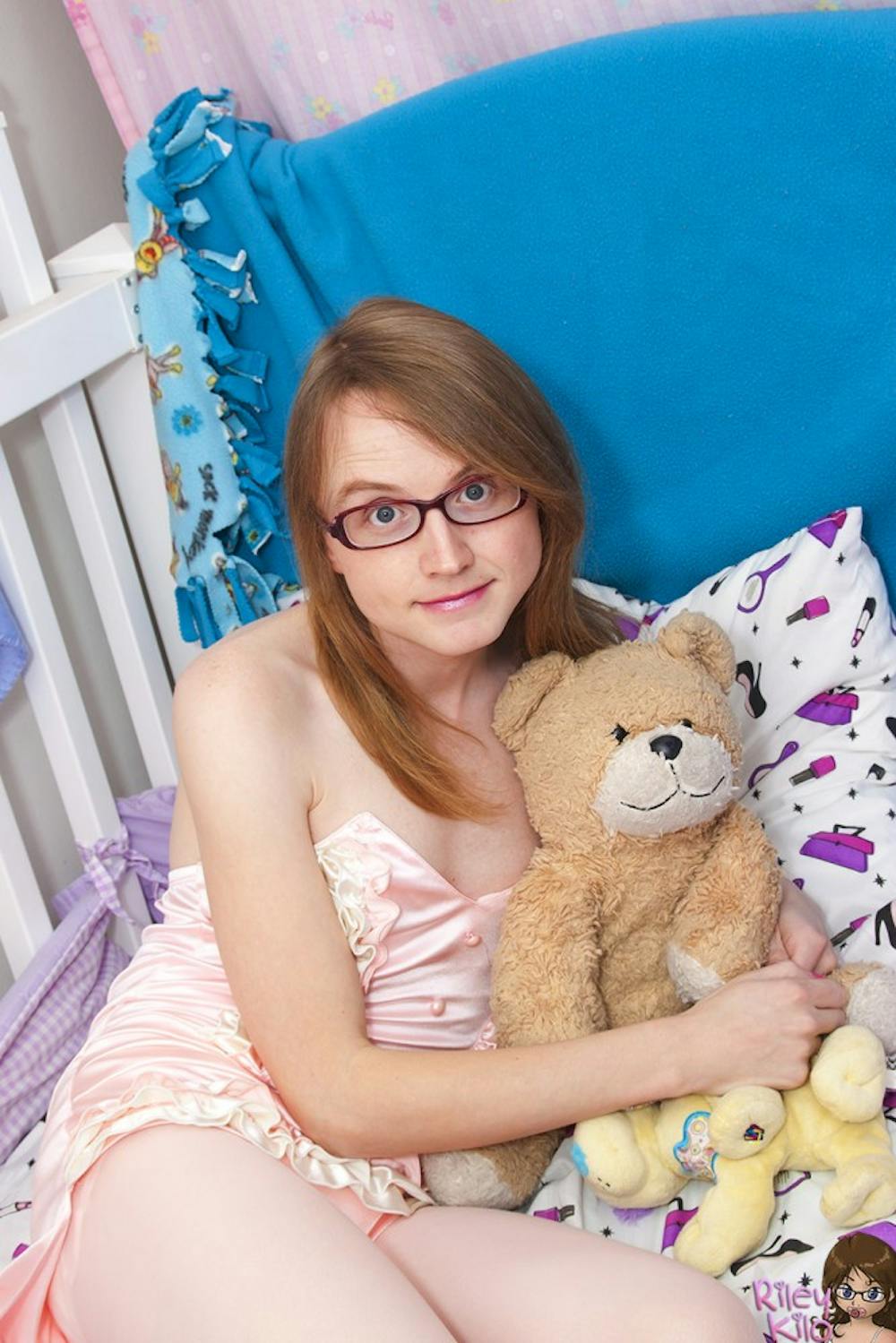
“Adult baby” Riley Kilo, who once appeared on “My Strange Addiction,” poses with a teddy bear.

Riley Kilo starred on TLC in 2011.

But she isn’t a glamorous toddler or a bride looking for her dream wedding dress. 

She is an adult baby.

The Buffalo native was featured on “My Strange Addiction” to teach viewers about her lifestyle choice on July 24, 2011. Kilo, a former porn star, is a prominent member of the adult-baby community, which is comprised of people with a paraphilic infantilism fetish which refers to, role-playing and regressing into an infant-like state. Many wear diapers and engage in age play, such as acting like an infant by watching children’s cartoons or using pacifiers. Despite its classification as a fetish, the lifestyle can be non-sexual, depending on the person. 

Kilo and other members of the community face an abundance of backlash because of their fetish. The adult baby/diaper lover –– AB/DL –– community is often misassociated with pedophilia, despite the latter being extensively denounced in the community. Those within the fetish community don’t associate regression with an attraction to children or minors, according to Kilo.

“The only thing I’m willing to say that would generalize the community is that we are all adults,” Kilo said. “I’m sure there are underage people that are interested in certain aspects of the community –– I know I started at an early age –– but everyone communicating online is an adult because we make it that way.”

Kilo’s interest in the lifestyle began at a young age. 

She started secretly wearing diapers at 13 years old, but her interest in diapers stems deeper than just physical comfort. 

Kilo, a transgender woman, recalls associating her diaper use with combatting gender dysphoria.

“Genitals can be a persistent worry for some people, and I’ve heard this from a lot of other transwomen in the community,” Kilo said. “For a long time, I liked wearing [diapers] because it was a good way to neutralize them. Wearing a big diaper essentially turns you into a Ken doll.”

Kilo, who didn’t have prominent celebrities like Miley Cyrus or Melanie Martinez to look up to for validation of her interests, spent much of her adolescence hiding her interests from those close to her because of their negative connotations, such as mental illness and medical concerns. 

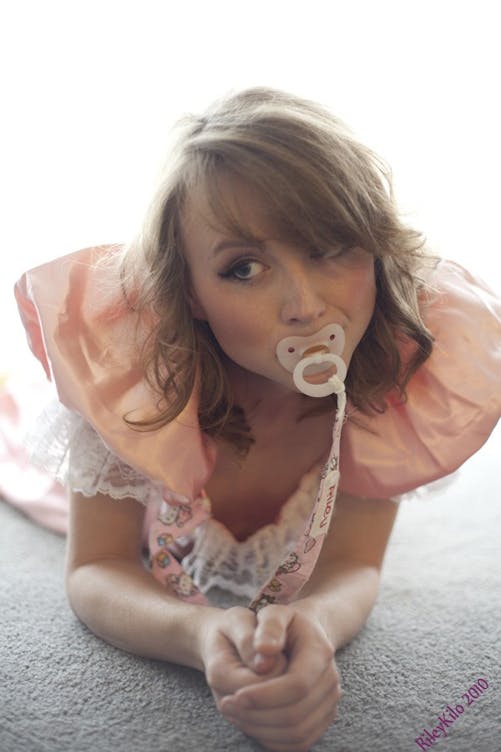
Courtesy of Riley KiloKilo lays on the floor with a pacifier.

“I never felt comfortable hugging anybody –– friends or family –– because I felt like there was something deeply wrong with me, and that by hugging them I was lying to them,” Kilo said. “I was this person inside that had these dark, bad things, which was the desire to wear diapers. That can really isolate you.”

Kilo has since found comfort in her interest and has even monetized the hobby.

Before she appeared on TLC in her 20s to discuss her “addiction” to being an adult baby, Kilo was used to being in front of a camera. By the time the episode aired on TLC, she worked for the amateur porn production company Homemade Media under the moniker Sadie Hawkins and independently as a camgirl. She now wears diapers 24 hours a day, every day of the week.

She incorporates her kink into her modeling and cam work, often appearing in onesies or diapers. 

The fetish is often broken down into two categories: adult babies who participate in regression and diaper lovers who eroticize wearing diapers. These elements often overlap, depending on the person’s preference.

Those who are attracted to regression compare it to the relationship between domination and submission, according to Kilo. 

Many members of the community are in relationships that mimic caretaking roles. This is seen across social media platforms, often as the “daddy-and-little” dynamic. 

Amber Fisher, a Buffalo native, recently began experimenting in the AB/DL fetish and age play

with her husband. The couple, who discovered the community while in their 40s, find sexual gratification in the caretaking aspects of the kink. 

“I like how he has total control over me and can make me do whatever he wants,” Fisher said. “But it doesn’t ever cross the line into the rougher ‘50 Shades of Grey’ kind of stuff, which I like.”

But not every member of the community participates for sexual gratification. 

Kilo says practicing regression also helps her relax. 

Courtesy of Riley KiloRiley Kilos poses in her bed, which she transformed into an adult-sized crib.

“I’m a person who’s a little high strung, as someone who’s been through a lot of trauma through my life,” Kilo said. “I’ve tried religion and yoga and everything else to find some sort of meditational peace, and nothing has really worked. I feel like this is my path to some level of comfort and peace.”

Kyle Heli*, a freshman at the Rochester Institute of Technology, joined the online community because of an interest in diapers. This interest evolved into the AB/DL fetish when he began experimenting with age play.

“Ever since I was five or six, I had always had this fascination with diapers. Every time we would go to the store, I would sneak off to the baby section and look at all the different kinds of diapers,” Heli said. “[I enjoy] the feeling of a diaper around my waist. It’s super soft and warm, especially when it’s wet.”

The community has grown substantially through social media platforms and forums and has become significantly more accessible, according to Kilo. There are now multiple conventions like TeddyCon and CAPCon, along with different pop-up stores that carry fetish supplies, such as diapers, pacifiers and clothing.

Kilo said her “nerdy” interest in diapers is comparable to collecting stamps or trains. 

“Like so many different hobbies, it’s something you can nerd-out about,” Kilo said. “I know all the brands, sizes and I can recommend certain kinds to people.”

Kilo feels she has lost her privacy since the episode’s debut and wants to keep her personal-life private moving forward. She has since moved to Pennsylvania and lives in an area with a thriving AB/DL community, which offers specific accommodations such as fetish-themed bed and breakfasts. She is currently writing a memoir about her life and experience as a sex worker within the AB/DL community. 

“It is perfectly fine to be uncomfortable with what I do or think what I do is gross or counterproductive or wrong, but it is my right to do that thing,” Kilo said. “It’s just a group of people that share a common interest that may seem strange at first but is completely innocent.”

*Name has been changed for anonymity at the request of the source.

Hell hath no fury like a pink tape measurer scorned (02-16-20)

U.S. retailers of women’s fashion needs a sizing standard

Samantha Vargas | UBSpectrum

For some women across the U.S., clothes shopping is a cathartic, fun experience.

For others, it’s a nightmare.

Every day, women across the country find themselves facing off against an invisible assailant; one that slowly eats away at their body image and self-confidence. The U.S. apparel market is a $341.6 billion enterprise, which is constantly changing and shaping culture, and fashion has been a pivotal aspect of self-expression since its conception. Yet for many women, teenagers and pre-adolescent girls, the exploration of fashion requires Rosetta Stone to decipher its seemingly ambiguous assortment of sizes. 

Many people might not experience sizing confusion with their curated H&M wardrobe, but an issue arises with the lack of sizing standards among women’s fashion brands. There is a definitive understanding between small and large or between a size 0 and a size 26, however, in reality these distinctions are ambiguous. Aside from understanding that large is a synonym for big, there is no standard measurements for this distinction. 

A size 8 dress from Michael Kors measures at 26.5 inches at the waist, while a size 8 dress from Chico’s measures at a 31-inch waist, according to a 2011 New York Times data collection. While four inches may not seem substantial, that amount of extra fabric would warrant a completely different dress size between these two U.S. brands. 

This may not seem like an actual problem on the surface. It might seem like a matter of trial and error, and ignoring the difficulties behind online shopping, I might have even agreed with that argument. But I’ve witnessed firsthand how these ambiguous numbers have torn down girls’ confidence. 

I recently took on a part-time job as a special occasion stylist at a well-known boutique. This shop, just like thousands of others across Buffalo, sells a variety of brands with a variety of sizing variants. 

And every week I see a girl cry.

I see teenage girls coming in, so excited for their prom, sobbing in our fitting rooms because “they’re usually a size 10.”

I see the happiness drain from the eyes of mothers-of-the-bride after the dress she was so excited about won’t zip up. 

I see bridesmaids put strains on their friendships because they don’t feel confident. 

And there’s nothing I could say to these women that would change the number they read on the tag. A number that doesn’t mean anything. 

I will be the first to acknowledge that different fabrics, silhouettes and body shapes all play a factor in how an article of clothing fits. But introducing a sizing standard across retailers, based on a modern standard of the bust, waist and hip measurement, would eliminate this unrelenting authority on self-confidence.

Of course I’m not implying that a standardized size would fit every person or every body type. But understanding a standard measurement would allow a standard alteration for women with diverse bodies, rather than have them guess what article of clothing would fit the best.

And the idea of a sizing standard is not a new concept for women’s fashion. The National Bureau of Standards originally published sizing standards for women’s fashion in 1958, which was later abandoned in 1983. The original conception for sizing standards was based solely on white women and female soldiers following WWII, but by implementing a more diverse pooling option, the concept of a standard should not be deemed implausible. 

What we now face is the era of vanity sizing; a time where thinness has equated itself with value. And while you may think times have changed with a cultural obsession with “thickness,” it’s important to remember that it still must be accompanied by a small waist to be deemed worthy. 

Eating disorders and self-harm still plague young men and women with the hopes that they’ll be able to reach a size 0, and the inconsistencies of sizing are not helping these cultural mindsets around body image. 

I am 21 years old and I have no idea what size I am.

I own clothes between a size 0, 5 and 10 that all fit.

I believe that standardizing clothing sizes would de-stigmatize the negative connotations around size and would only contribute to the body positivity movement. It’s time for people to understand there is nothing wrong with not being a size 0 and to strive for being happy with who they are. 

You can lead a television executive to water, but you can’t make him drink (02/05/20)

‘Bojack Horseman’ perfects traditional adult animation

Samantha Vargas | UBSpecrum

EDITOR’S NOTE: This column contains spoilers. 

The reign of Fox’s Friday night animation line-up is over.

For years, programs full of shallow writing and cop-out comedy have remained at the forefront of the adult animation community. Seth Macfarlane has been able to build an empire full of fart jokes, visual gags and lazy cultural references. 

But move over “Family Guy,” there’s a new challenger fighting for the crown, and it has a rightful claim to the throne. 

Netflix’s “Bojack Horseman” should be the standard for adult animation.

The series, which concluded its sixth and final season on Jan. 31, was able to demonstrate such a momentous level of writing and character development, that it raises the standard for what should be funded by production companies moving forward. The show follows the life of former ‘90s sitcom star, Bojack Horseman, as he maneuvers through modern-day “Hollywood” and is pushed to come to terms with his declining social relevance

But the show is so much more than that.

On its surface, the show explores substantially real themes like substance abuse, sexism, trauma and depression. Yet throughout its relatively short run, it also threads a variety of other ideas through its characters and subplots. It’s able to explore serious concepts like abortion and coming to terms with one’s sexuality, yet still balance enough humor to keep viewers entertained. 

But despite its brilliant writing and performances, it’s understandable that the show may not appeal to all audiences. There will always be people who shy away from programming that confronts the reality of making –– sometimes substantial –– mistakes.

Bojack is a sexist, ego-centric addict who was never really expected to grow up and take responsibility for himself. These ideas continue throughout the show, while viewers suffer through watching him relapse into drugs, alcohol and narcissism. 

It is always a challenge to pitch a show based around a troubled anti-hero, and creator Raphael Bob-Waksberg knew he had to balance its levels of ridiculous humor with introspective, serious messages.

During an interview with NPR, Bob-Waksberg said, “It’s not that you’re necessarily making light of the horrifying circumstances, just that you use your humor to survive.”

But that’s why so many fans relate to the balance between the two extremes, since it’s able to mirror so much of their realities.

While the show is pivoted around Bojack’s character, it still develops a variety of substantial side characters, each with their own story and flaws, and the series finale was able to tie up its remaining character arcs and plots, yet still end with the understanding that the characters’ lives will continue to progress. 

While I was disappointed when hearing the series was cancelled, I now realize it was vital for the show to continue with just enough time for the script writers to develop a satisfying ending. Although Matt Groening seems to be content with running “The Simpsons” into the ground, there is not a single television show that needs 30 seasons, “Bojack Horseman” included. 

A common trope that seems to exist across all of the entertainment market is the overextension of a popular television series. Between “The Office” and “That 70’s Show” or “Family Guy” and “Rick and Morty,” when a series continues beyond its character arcs, it muddles any of the spark it may have brought through its original storyline.

Bob-Waksberg was able to harness a nearly-perfect three-act narrative for all of the shows characters. Each felt grounded in reality –– whether it was Princess Carolyn balancing her personal and professional life or Todd regaining a relationship with his mother or Diane being able to control her looming depression –– each character was able to fulfill a long-term goal that had been set throughout their introduction. 

Every character except Bojack.

But that’s okay. In fact, that’s what makes the finale so great.

Throughout the show, viewers find themselves conflicted about whether or not to root for Bojack to succeed. While he is the titular protagonist, he isn’t framed in a heroic light. He isn’t the hero of the series, but that doesn’t make him the villain either. Through his highs and his very low-lows, he is framed as a caricature of a real, troubled person. 

His lack of a perfectly wrapped-up ending demonstrates the cyclical nature of his life and his faults, and the potential growth he could make after having everyone in his life move on from him.

The viewer hopes he will try, but they also know the pattern.

And the series’ great writing and character development is what will make it go down in history as an example of what television producers should be looking for, and what consumers should be demanding. 

Letting the cat out of the bag on veterinary scams (01/30/20)

How I lost over half my savings by being uninformed on fear mongering

Samantha Vargas | UBSpectrum

On Aug. 25, I began to lose over half of my savings.

But it wasn’t the result of a gambling problem or a bad investment, it was to the person who I thought was saving my cat’s life.

My veterinarian.

My vet charged me $850 in less than an hour and in a state of emotional distress, I paid it. My cat, Simon, was only one year old and never had any previous health problems, yet the vet said he was going to die. It took three more appointments and an additional $600 bill before I considered getting a second opinion. 

In the middle of medication trials, the restaurant I worked at unexpectedly closed. I was suddenly unemployed and still searching for answers, and my savings continued to disappear. 

It all started when I brought Simon in for a preliminary appointment the day before the fall semester began after I noticed him shaking, assuming it was a pulled muscle.

They asked my permission to run “a few blood tests” after testing his motor skills for roughly ten minutes, but before any results came back, they confidently told me Simon had kidney failure. 

I knew that was a death sentence.

I went home and waited for the inevitable call, spending the rest of the day crying. Yet when the test results came back, there was nothing wrong with him. Every single one of his tests came back normal. 

I returned days later for a follow-up appointment, but the team of veterinarians still did not have any answers for me on Simon’s illness. They sold me a cocktail of different medications throughout the month to address his tremors, but nothing worked. 

And while I now realize I should have been more assertive, I assumed these professionals were doing what was best for my beloved pet. I assumed we were all on the same page, and that Simon was facing some rare disease or genetic condition.

Yet after a month of stress and bills, it only took my newfound –– and current –– vet one appointment to diagnose and medicate Simon for under $100.

They diagnosed him with toxoplasmosis, a common disease which can be treated with a few rounds of antibiotic and statistically is experienced by 30-50% of domesticated cats, according to veterinarian Paul Allen.

Throughout my time working with this prominent Amherst clinic, not a single person could give me a straight answer on what routes they were taking with his diagnosis and treatment.

But after months of research and consultation, I realized I was wrong. There’s no excuse for the continuous misdiagnosis of a common disease by trusted medical professionals.

And this incident is not an isolated case across Amherst veterinary clinics.

I adopted Simon in August 2018 and wanted to give him the best care possible. I had made a 20-year commitment to this little orange kitten, and I was prepared to follow through with anything he might need. This included finding the best local veterinary office in the area. I scoured Yelp and Google reviews and even did a few drive-bys of all the different options nearby. 

To this day, the office I initially chose continues to uphold impressive scores from different rating sites. Yet scattered throughout the superficial, non-specific positive reviews from longtime clients is the same message: the staff pushed unnecessary treatments and significantly overpriced medications. 

It has been almost half a year since this ordeal, and I have not been able to regain the same financial security I had in the summer. I had to work three different jobs throughout winter break trying to dig myself out of credit card debt to cover the cost of vet bills. 

It’s time for people, myself included, to start protecting their finances from predatory situations. Everyone knows the self-serving stereotypes around car salesmen and lawyers, but it’s important to know that there are tactless individuals in every profession. This could happen to anyone, and for many pet owners it could lead to worse than just credit card debt.

And while I trust my current veterinarian, I’ll never allow myself to be uneducated or vulnerable again.